Tuesday, 18 January 2022

TO TOUCH OR NOT TO TOUCH? (OR RETOUCH TO BE MORE PRECISE)...


It's a fact of life that tin corrodes and discolours over time.  I no longer have my original Chad Valley pillar box money bank (bought in Southsea in December 1978 and owned until its demise in 1989), but going by the above old photo, the gold coloured base, though dulled, doesn't look corroded.  However, in the second photo (actually taken a short time before the third), neither do the two replacements I obtained around a year or two back - whereas in the third photo, the corrosion is obvious (I showed them out of sequence to better illustrate my point).  That means, despite not being visible in the first photo, my original bank may've been similarly affected, though I can never know for sure unless I have other, clearer and sharper versions somewhere.  (Probably best to enlarge each photo to better see what I'm talking about.)


Anyway, look at that third photo again and then compare it with the fourth photo (below) taken only today.  Last night I decided to improve the look of the bases, so I masked off the upper part of each bank and applied some gold acrylic spray paint - what a difference!  However, this post isn't just to blow my own trumpet, it's also so I can ask a question of fellow collectors of toys and comics, etc.  Which is - would you attempt to improve the cosmetic appearance of something (assuming you had the skill to do it), or do you believe that things should be left as they are, despite any flaws, imperfections or damage?  I know that when it comes to preserving monetary value, some people believe that collectable items should remain untouched, but the financial aspect has never been a concern of mine.  I just want things to look as good as they can.

That's why I colour touch comic covers, discreetly repaint parts of toys, and generally try to maximise their cosmetic appearance, but I wondered what the rest of you crazy Crivvies think.  To retouch or not to retouch?  If you have an opinion on the subject, feel free to share it in the comments section.

And just to more fully demonstrate exactly what I mean, below is a comic cover in 'before and after' condition.  Achieved by the application of acrylic inks, I think it looks much better after I've worked on it.  Agree or disagree?  Click to enlarge for a clearer comparison.

MARVEL AT RED SONJA #1 - IT'S DYNAMITE...


Copyright relevant owners

I recently showed you the Dynamite Comics facsimile of Red Sonja #1, but then I decided to obtain the original Marvel Comics version to replace the one I had back in the '70s.  So that's it above and also below, alongside the Dynamite copy.  I've just acquired issues 2-14 as well, so once I track down #15 (last ish) I'll do a cover gallery for all you cavortin' Crivvies to ogle at.

Right, hands up all those who fancied Red Sonja when they were a teenager?  Tell all in the comments section.  Go on - you've got nothing better to do at the moment anyway.  (Or you wouldn't be reading this load of ol' mince, would you?)

The BATMAN 'FORGERIES'... (A FABULOUS FLASHBACK)

Images copyright DC COMICS

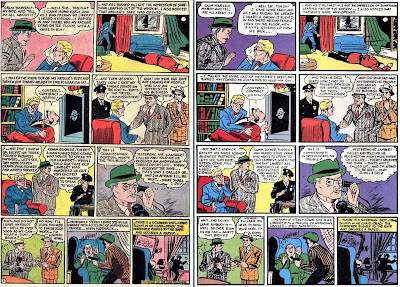
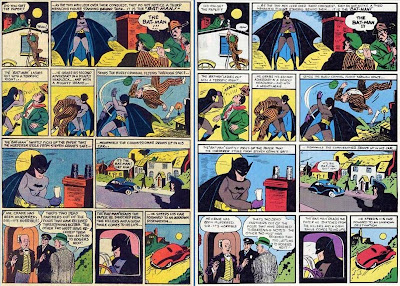
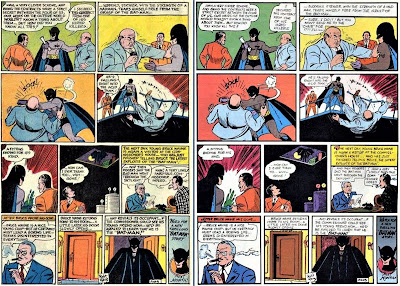
In the May 1969 issue of DETECTIVE COMICS #387, the first BATMAN adventure was re-presented to readers of the time.  Note that I said 're-presented' and not 'reprinted', because the story featured was a re-creation, a 'tracing', effectively, of enlarged copies (in all likelihood) of the printed pages from issue #27 in 1939, and not from surviving period-proof copies from the editorial files.


At the time, this was common practice whenever NATIONAL/DC didn't have proofs or original artwork from which they could reprint a particular tale. This tracing was reused in Batman FROM The '30s To The '70s, Detective Comics #627, and Batman ARCHIVES Vol. 1.  I don't recall whether it was used in the FAMOUS 1st EDITION, so perhaps someone out there can let me know.


Out of all the 'reprints' of this tale, the only one I've got which seems to come from more accurate proofs is the MILLENNIUM edition published in 2000.  Strange that it took 31 years for DC to republish the original story (in standard comic-sized editions at least), instead of what was essentially a forgery.


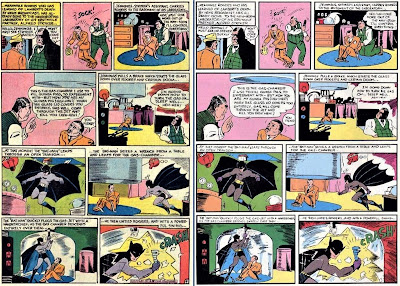
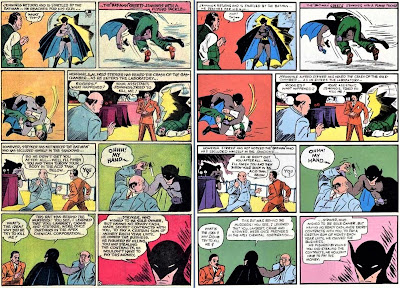
Anyway, just for you, here's the original (left) and re-created pages (right) side-by-side, so you can play 'spot the difference'.  Also included is a photo of a page from an actual, original 1939 issue (as printed in Batman THE GOLDEN AGE), so that you can compare it to the other two examples on view.


Go on, play 'Dark Knight Detective', and see if you can spot all the subtle (and not-so-subtle) distinguishing points between both versions of the pages.  Unfortunately, the fact that a tracing of the premiere story was used in the Archive Editions volume makes a mockery of its claim to be the "definitive collection".


If you happen to own the aforementioned Famous 1st Edition issue of this tale, take a look at the story's second page.  If the middle of the top two tiers are out of alignment then the tracing was used as the source, not proofs of the original printing.  Unfortunately, I can't remember if I've got it or not, otherwise I'd check for myself.


As promised, below is a slightly angled photo of page 3 from an original 1939 issue, as reproduced in the excellent book on Batman by writer and comics historian, the late LES DANIELS.


So there you have it.  Unless you're lucky enough to own an original issue of Detective Comics #27 or the Millennium Edition reprint (the jury's still out on the Famous 1st Edition), then the chances are that you've never actually seen the first Batman tale - only a mere paltry imitation.  Just think - "You wuz robbed!"  Better call Batman.  Oh, and just for completists, here's the cover to ol' Bats' debut appearance.


******

Click on images to enlarge, then click again for optimum size.  Unfortunately, the interior comparison pages are not quite as sharp as I'd like, 'cos I enlarged them from smaller sized images.  They'll still do the job though.